“Things…. can only get blurrier…”
‘Call me Tony’ and the campaign song that ushered in a new era of misinformation and disinformation
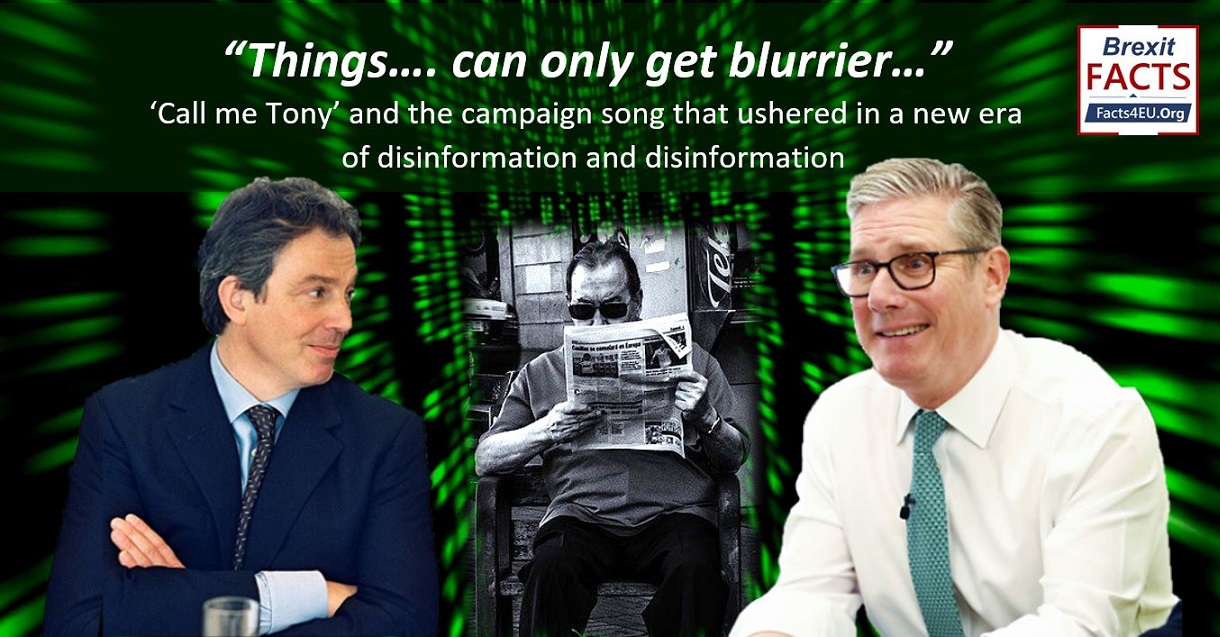
Montage © Facts4EU.Org 2025
The Freedom of Information Act 2000 – a 25-year retrospective view - Part I
In the wake of yesterday’s shocking misrepresentation of the lead-up to the Budget by the Prime Minister, it is timely to present a guest article about the Freedom of Information Act. The article, written by a journalist going under the nom de plume ‘Checkpoint Charlie’, is a personal view on the state of openness by government and its agencies – or lack thereof.
Today we present Part I, giving the background to the Act which purported to usher in a new age of transparency in which the public would be much better informed about the actions of their government. For the benefit of our younger readers, the title refers to the song which was played at Labour Party rallies ahead of the address by their leader, and soon-to-be Prime Minister, Tony Blair.
“Things…. can only get blurrier…” - Part I
A 25-year retrospective on Tony Blair’s ‘Freedom of Information Act 2000’
By Checkpoint Charlie
You’re a politician and you have a policy idea. What are the most important things to do first? Set out the objectives clearly, define the specifics of how these will be achieved, then have the policy costed and ensure the improvements it will deliver are well-described and quantified?
Well, you might spend a few minutes on this but then you turn to the most important things: what to call it and how to communicate it.
Let’s go back to those early, heady, Blair years. We are three years in from the landslide victory and along comes the idea for a ‘Freedom of Information Act 2000’. What a wonderful name. This is something the public will take to instantly. People like the sound of ‘freedom’ and - as ‘information is power’ - it suggests they will immediately know more, which empowers them. Gone will be the days when the public felt they were kept in the dark about what is going on in government.
“Marvellous!” cries Tony (for let’s call him Tony). “Ooh… It sounds so, you know, ‘Millennial’…. This will make me, you know, even more popular than I already am!”
He looks up and grins at the man on the other side of the desk.
“You know you don’t half come up with some good ‘uns, Alastair. First the People’s Princess, now this. They should give you a medal.”
“Hmph,” grunts Campbell. “You mean you should….”
The Freedom of Information Act 2000
The Freedom of Information Act 2000 (FOI Act) was initiated at the turn of the Millennium under Prime Minister Blair and came into force five years later, after some debate. Somewhat ironically the final version was severely restricted in its scope by the time it reached the statute book. In some ways its list of exemptions might make it more appropriately called the DOI Act: the Denial of Information Act, and we shall come on to that. Suffice to say it is allegedly the most exempted such Act in the World.
In any event it is in principle open to almost anyone to use and to ask almost any public body anything. Over 100,000 bodies in England, Wales and Northern Ireland may be questioned, from government departments to local schools, and these questions can come from everyone including private individuals, businesses, all manner of groups, and of course journalists. The Scots have their own version, naturally.
Watch out - I’m about to give you information freely
In the interests of transparency and in the spirit of this article’s subject matter, here I must declare an interest. I work freelance and research and write information on a daily basis, as well as working on contract for a major TV news organisation. (If you submit a Freedom of Information request I might even tell you which one.)
Unlike media organisations, my interests do not lie in reading the papers to see what others have written on a subject, then rehashing it into an apparently new piece of work in order to churn out six such stories per day. This is now the norm expected of young journalists working for many newspapers. They are then judged daily by the number of ‘page views’ their articles attract in the digital version of their paper, which of course leads to ‘click-bait’ headlines and profoundly disappointing content.
We rely wholly on patriotic members of the public to survive. Please donate today if you would like to continue reading us tomorrow, next week, and the weeks after.
Any credit card user
Quick One-off

From £5 - £1,000
Monthly

From £3 per month
Paypal Users Only - Choose amount first
Quick One-off
Monthly
Don't leave this to someone else. You are that 'someone else'.
Do you remember something they used to call ‘investigative journalism’?
Call me ‘old school’ but I prefer the Woodward and Bernstein style of investigative reporting. To put this into the British perspective many readers will recall the days when the Sunday Times had its ‘Insight Team’, started by the legendary Editor Harold Evans. These were the days when good journalists were given weeks to delve into stories no-one else had time to question and even less time to pursue. And some of the successes were spectacular. Aside from the obvious Watergate exposé in the Washington Post in the States, in the UK the Thalidomide scandal comes to mind.
For the most part, those days have long gone. Many journalists these days are content to reproduce press releases (mostly written by former journos) from government departments or public bodies, to embellish them with quotes from politicians, and then to present these as news reports.
These young (they are mostly under 30) journos also know what the priorities are. Immigration sells. The Royal Family – no matter how trivial the item – sells big-time. Disaster sells, particularly if there’s a death toll which can be updated regularly each day. Then there’s the ‘Topic of the Moment’, which will consume 80% of all output for anything from 12 hours to several days, as if all other news had simply ceased. It is the latter that explains why whichever is your favourite TV news channel turned us all into Catholics for several days when the last Pope passed away.
Where reality intrudes on a worthy idea
Turning back to the FOI Act, this should be a godsend to me and to those like me. A statutory obligation on those in Whitehall and elsewhere to answer our questions truthfully? On any given story, all our dreams should be fulfilled by the openness this espouses and engenders and, failing that, we should get it in one fell FOI request.
If this were true I would not be writing this and I suggest you would probably have stopped reading several paragraphs ago. Putting to one side the hugely-increased availability of news via so many outlets, do you feel you know more today about what government is really doing than you did 25 years ago? If your answer is in the negative then it must be asked what the FOI Act was all about and why it hasn’t delivered.
In Part II I will give you the inside track on how the FOI Act works in practice. (Spoiler alert: it doesn’t.) You will learn exactly how the process fails to deliver and even hear a specific example. Then I will consider the implications, whether this matters, and how it is indicative of the ways in which our society has been changing for the worse.
- By Checkpoint Charlie, Dec 2025
Observations
In Part II, Checkpoint Charlie lifts the lid on the scandalous ineffectiveness of this Act. Having read it we can testify to its accuracy.
The author also asks some difficult questions about what this says about our society. Given the Facts4EU team are still reeling from Sir Keir Starmer’s complete reinvention yesterday of the Budget process which had been pursued by Rachel Reeves, it seems an appropriate moment to raise the whole question of truth and transparency.
Please, please help us to carry on our vital work in defence of independence, sovereignty, democracy and freedom by donating today. Thank you.
[ Sources: Checkpoint Charlie ] Politicians and journalists can contact us for details, as ever.
Brexit Facts4EU.Org, Tues 02 Dec 2025
Click here to go to our news headlines
Please scroll down to COMMENT on the above article.
And don't forget actually to post your message after you have previewed it!
Since before the EU Referendum, Brexit Facts4EU.Org
has been the most prolific researcher and publisher of Brexit facts in the world.
Supported by MPs, MEPs, & other groups, our work has impact.
We think facts matter. Please donate today, so that we can continue to ensure a clean Brexit is finally delivered.
Any credit card user
Quick One-off
From £5 - £1,000
Monthly
From £3 per month
Paypal Users Only - Choose amount first
Quick One-off
Monthly
Something to say about this? Scroll down for reader comments